
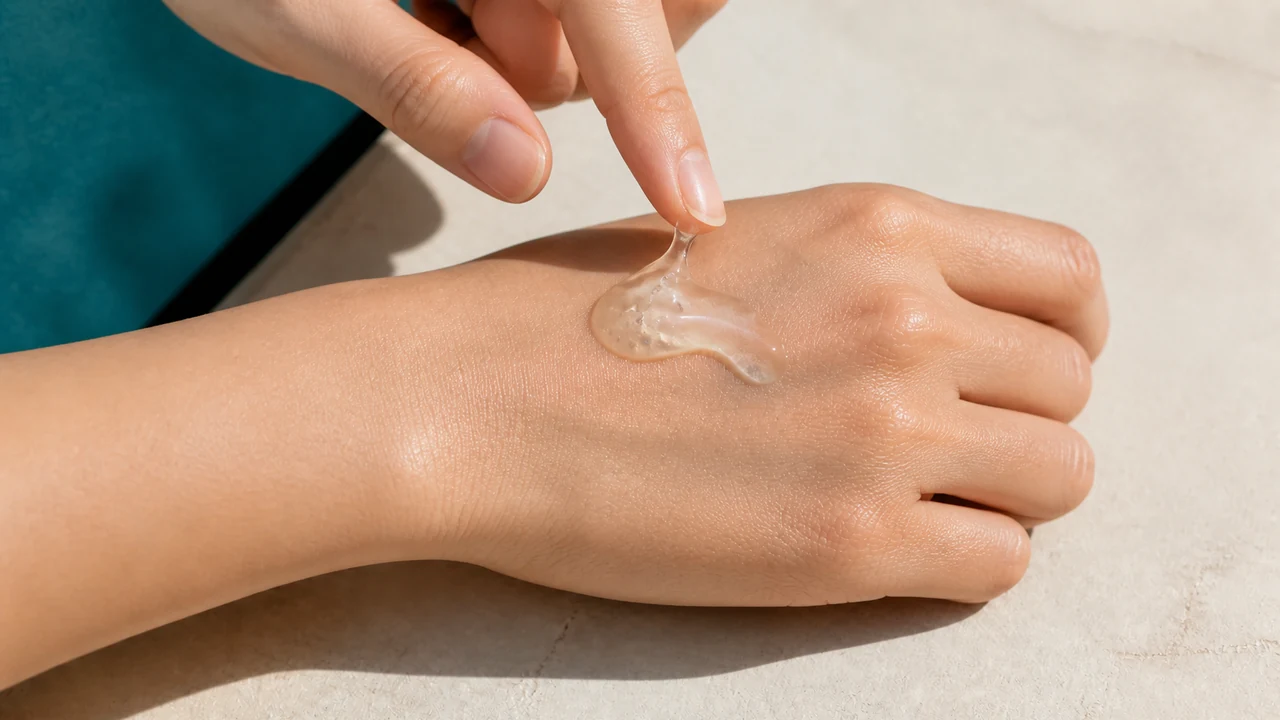
Editorial illustration: AI-generated imagery; any people or packaging shown are illustrative, not the reviewed product or evidence of results.
Cautious product introduction
Quick answer
Before using a new skincare product across your face, apply it to a small, repeatable test area exactly as directed and watch for a reaction over several days. The American Academy of Dermatology recommends applying a normal amount to a quarter-sized area twice daily for seven to ten days. A rinse-off product should remain only as long as its directions say. Stop and wash the product off if the area becomes red, itchy, swollen, painful, or otherwise clearly irritated.
This home check may help reveal an obvious reaction before full-face use, but it is not the same as diagnostic patch testing performed by a dermatologist. It also cannot promise that a product will be comfortable everywhere on the face or after weeks of use.
Key takeaways
- Test one product at a time so the result is interpretable.
- Use the same amount, frequency, and contact time you expect to use later.
- Keep the rest of the routine stable during the test.
- Do not test on broken, actively inflamed, or recently treated skin.
- Stop promptly for a clear reaction and seek professional care for severe or persistent symptoms.
Choose a useful test area
The underside of the arm or the bend of the elbow is commonly suggested because the area can be observed and is less likely to be washed repeatedly. Choose intact skin that is not already itchy, scraped, sunburned, or affected by a rash. A reaction on compromised skin would be hard to interpret and may be more intense than normal use.
Keep the test location consistent. Moving the product to a different spot every day makes it harder to separate a product response from friction, clothing, shaving, or another exposure. Take a simple dated note rather than relying on memory. Record the product, location, amount, start time, and any visible or sensory change. A photograph under similar lighting can document a change, but it does not diagnose its cause.
Match the product’s real contact time
A leave-on serum or cream stays on the test area. A cleanser or mask should be rinsed after the time given on its label. Leaving a rinse-off product on for hours does not create a more rigorous test; it creates an exposure different from intended use. Follow storage and usage instructions as well. A degraded or contaminated product cannot provide a meaningful result.
Use the product alone on the small area. Layering an exfoliant, retinoid, fragrance product, or occlusive dressing over it can change exposure and make the result ambiguous. If a clinician has given you product-specific instructions, those instructions take priority over a general consumer guide.
Observe, do not provoke
The goal is not to push the skin until something happens. Check for redness, itching, swelling, hives, unusual warmth, persistent burning, blistering, or increasing discomfort. Mild sensory effects advertised as a feature should not automatically be treated as proof that a product is working. If the sensation worries you or increases, remove the product and stop the test.
If there is no reaction during the test window, introduce the product to the face gradually while leaving other variables unchanged. Begin at the label frequency or less often when the directions allow. A successful arm test lowers uncertainty; it does not eliminate it because facial skin, eyelids, lips, and neck can respond differently.
If a reaction appears
Gently wash the product off and do not apply it again merely to confirm the reaction. The AAD notes that a cool compress or petroleum jelly may help with a minor reaction, but severe symptoms or symptoms that do not settle require professional advice. Swelling involving the eyes or mouth, breathing difficulty, widespread hives, blistering, or rapidly worsening symptoms need urgent medical attention.
Save the ingredient list and product name. A dermatologist may need them when investigating allergic contact dermatitis or another cause. Do not label yourself allergic to a single ingredient based only on an at-home product test: finished formulas contain many ingredients, and irritation is different from allergy.
At-home testing versus medical patch testing
Dermatologist-supervised patch testing applies standardized allergens under controlled conditions and includes timed professional readings. It is used to investigate delayed allergic contact dermatitis. An at-home check uses one finished consumer product and cannot identify which ingredient caused a response. If reactions recur, spread, or remain difficult to explain, stop experimenting and ask a dermatologist whether formal evaluation is appropriate.
Evidence limits
Professional guidance provides a practical screening process, not a guarantee of safety or compatibility. Delayed reactions can occur after the test window, and cumulative irritation can appear only with broader or more frequent use. The instructions also cannot account for prescriptions, recent procedures, diagnosed skin disease, known allergies, pregnancy-related care questions, or a history of serious reactions.
Medical boundary
This article is general education, not diagnosis or individualized treatment. Do not use it to test a product that a clinician has told you to avoid, to challenge a known allergy, or to manage a severe reaction. Contact a qualified health professional when symptoms are significant, persistent, recurrent, or uncertain.