
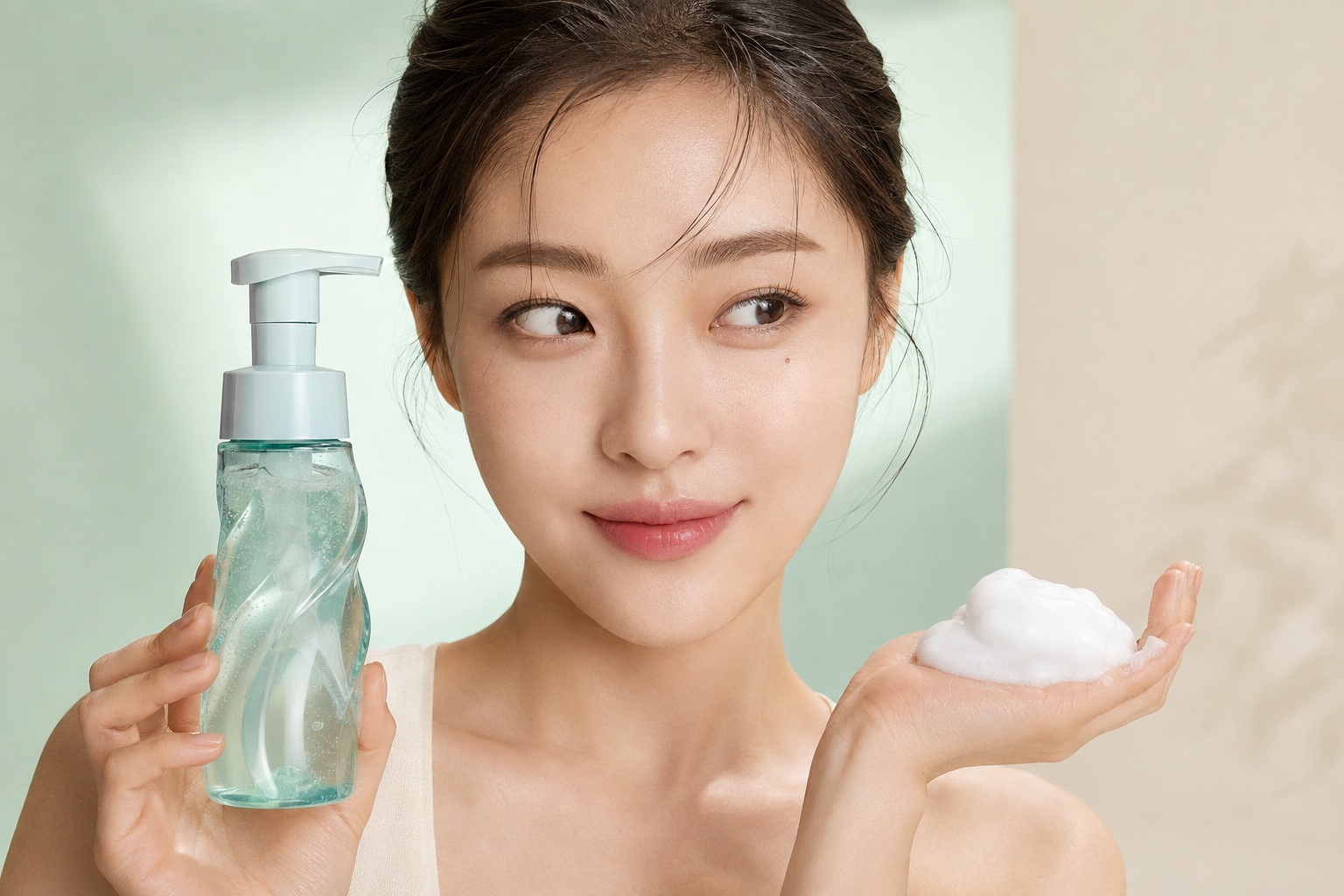
Editorial illustration: AI-generated imagery; any people or packaging shown are illustrative, not the reviewed product or evidence of results.
Beginner routine
Quick answer
A useful beginner K-beauty routine can be only three steps: a gentle cleanser, a moisturizer that feels comfortable, and broad-spectrum sun protection during the day. The value of this structure is not that three is a magical number. It is that each step has a clear job, the routine is easy to repeat, and a problem is easier to trace than in a ten-product lineup.
Start with these basics for at least a couple of weeks if they are comfortable. Add an optional product only when you can name the problem it is meant to address and the evidence you would use to judge it. More layers are not automatically more Korean, more advanced, or more effective.
Key takeaways
- Morning: cleanse only if needed, moisturize if needed, then use sun protection.
- Evening: remove sunscreen or makeup, cleanse gently, then moisturize.
- Introduce one new product at a time and keep a short observation period.
- Choose by formula, finish, and tolerance rather than the number of steps.
- Persistent pain, rash, swelling, cracking, or severe acne needs professional assessment.
Step 1: cleanse without turning cleansing into a treatment
The basic purpose of cleansing is to remove soil, makeup, sunscreen, sweat, and excess surface oil without leaving the skin persistently tight or uncomfortable. A low-foam or cream cleanser can suit some people, while others prefer a gel. The format matters less than the result and the complete ingredient list.
In the morning, rinsing with water may be enough for some people; others prefer a small amount of cleanser. At night, water-resistant sunscreen or makeup may require an oil-based first cleanser followed by a water-based cleanser. That optional double cleanse is a practical removal method, not a rule everyone must follow. Use lukewarm water, avoid prolonged scrubbing, and pat rather than rub.
If the face feels increasingly tight, hot, or rough after every wash, do not solve the problem by buying another active. First check water temperature, frequency, cleanser amount, wash time, and whether multiple cleansing steps are necessary.
Step 2: use moisturizer as the stable base
A moisturizer combines water-binding ingredients, emollients that improve feel, and often more occlusive ingredients that reduce water loss. Lotions tend to feel lighter; creams and ointments tend to provide more occlusion. The American Academy of Dermatology generally favors creams or ointments over lotions for very dry skin, while personal comfort and climate still matter.
Apply moisturizer to slightly damp skin if that feels comfortable. A product does not need every fashionable barrier ingredient to be useful. Glycerin, petrolatum, dimethicone, ceramides, fatty alcohols, squalane, panthenol, and many plant oils can appear in sensible formulas, but the finished product determines texture and tolerance. A long ingredient list is not automatically better or worse.
When trying a new moisturizer, keep cleanser and sunscreen unchanged. This makes it easier to notice whether comfort, dryness, shine, pilling, or congestion changed. People with a history of fragrance reactions may prefer products explicitly labeled fragrance-free while still checking the full list.
Step 3: protect against ultraviolet exposure
During the day, use a broad-spectrum sunscreen that meets the rules for the market where it is sold, and follow its labeled amount and reapplication directions. The best formula for a routine is one that you can apply adequately and consistently. Korean sunscreens are popular for elegant textures, but country of origin does not remove the need to check the label, seller, expiration, and local regulatory status.
Sunscreen is the final skincare step before makeup. Do not rely on a small amount mixed into moisturizer or foundation unless the product directions specifically support that use. Shade, clothing, hats, and avoiding intense sun are useful companions rather than substitutes for labeled sunscreen use.
How to add a fourth product
Wait until the three-step routine is stable. Then define one target: for example, makeup removal, dryness in winter, a visible pigment concern, or a clinician-discussed acne plan. Choose one addition and introduce it cautiously. A hydrating toner may improve comfort but is optional. A serum can carry useful ingredients but is not inherently stronger. An exfoliant or retinoid can increase irritation and deserves slower introduction and closer attention to directions.
Do not add several products after one good shopping session. If a reaction develops, the entire routine becomes difficult to interpret. Use the same principle for samples: small size reduces cost but does not make simultaneous testing more informative.
A simple weekly check
Ask four questions: Is the routine comfortable immediately after use? Is discomfort increasing over the day? Can I identify which product performs each job? Can I repeat this routine within my time and budget? If the answers are poor, simplify before replacing everything. Stability is a performance feature.
Evidence limits
General dermatology guidance supports gentle cleansing, moisturizing, and sun protection, but it does not identify one universal formula or sequence for every person. Terms such as sensitive, dehydrated, barrier damaged, non-comedogenic, and hypoallergenic can be used differently across brands and markets. This guide does not rank products or infer that one ingredient treats a disease.
Medical boundary
This routine is educational and is not a treatment plan. Seek medical advice for persistent or severe itching, pain, swelling, cracking, bleeding, infection signs, widespread rash, sudden pigment change, or acne and eczema concerns that need diagnosis. Follow a clinician’s instructions over this general framework.